Exploring how organisms respond to global change in an ecological context
Exploring how organisms respond to global change in an ecological context
Research interests
Broadly, I am interested in how species are responding to the unintended natural experiment of global change driven by humans. I’m motivated to explore how multiple stressors impact species responses and how these responses change across time and space. In exploring these responses, I study evolution on rapid time scales and plasticity as responses to novel environmental conditions.
These research themes are part of the broader intersection of ecology and evolution. Until quite recently, these fields in biology have operated in isolation but we now recognize that they take place on similar time scales.1^,^2 This means that interactions between species and their environment (ecology) can both cause and be caused by evolution.3 I seek to use this framework of Eco-evo dynamics to address major questions confronting biology including responses to climate change and global biodiversity declines.
Currently in my PhD research in Seth Rudman’s lab, I have focused on the following themes and projects that form both my dissertation work and inform my broader interests:
Evolutionary responses to winter and trade-offs with novel stressors
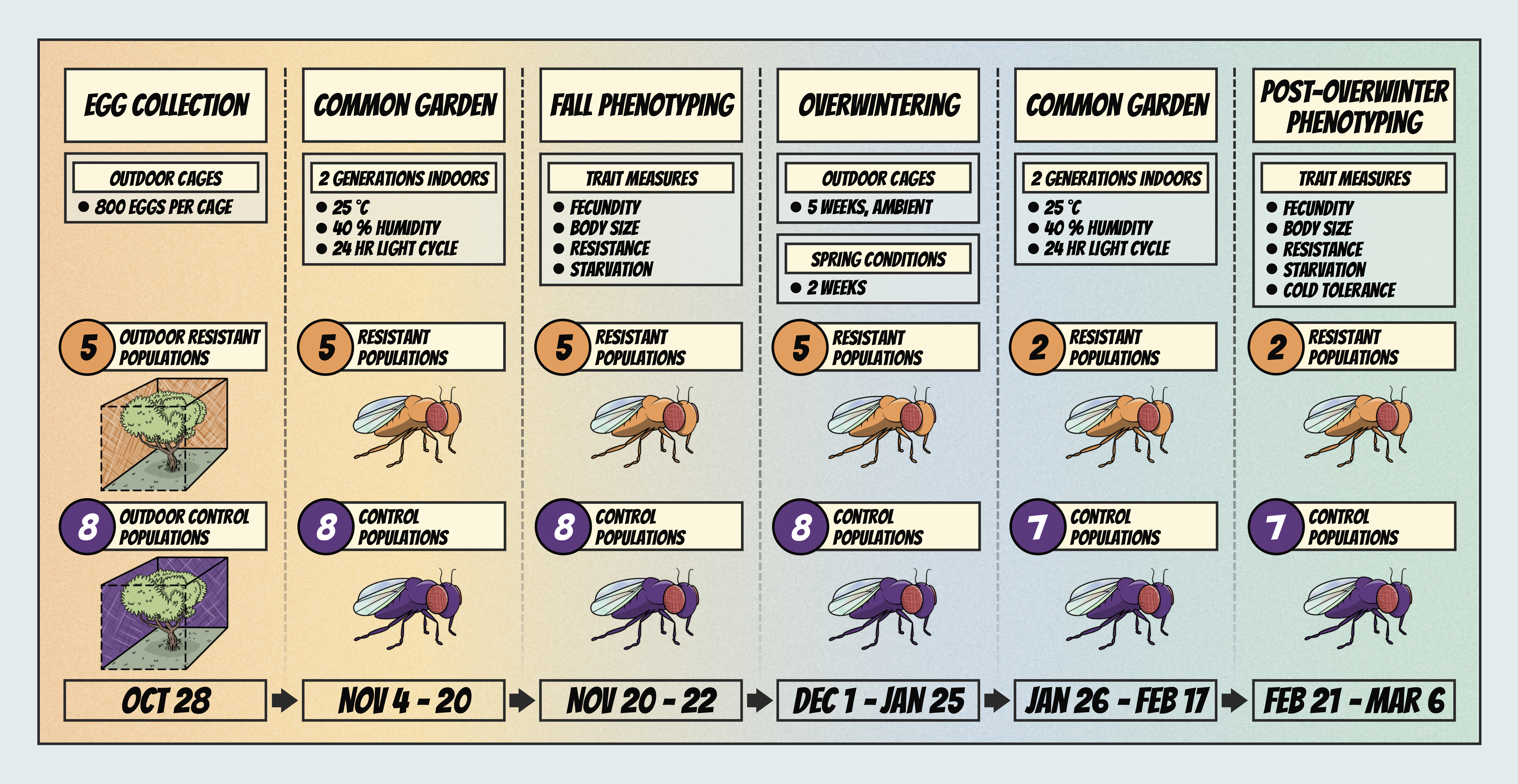
- Winter is challenging for ectotherms and the harsh conditions are likely a strong driver of divergence among populations. When conditions covary with other, novel stressors there is a strong potential for physiological trade-offs. We investigated evolution across winter and trade-offs with insecticide resistance using field populations of fruit flies (Drosophila melanogaster). See what we found in this paper!
 {width=”458”}
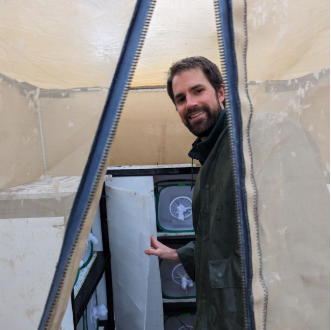
In addition to allele frequency shifts in physiology that enable overwintering success, it is likely that behavioral divergence among populations also plays a strong role. By using choice trial set ups with fall-collected fruit flies, we tested for the evolution of food choice and nutritional variation in overwintering success.
 {width=”204”}
Factors underlying the evolution of plasticity
- Plasticity, or the flexibility of traits of an individual, can be an important mechanism of species persistence under changing climates. Importantly however, this capacity can evolve among populations. The extent to which the evolution of plasticity is beneficial or when it is maladaptive to populations, however, is not clear. We tested how broad level evolutionary processes of selection for insecticide resistance and gene flow affected the evolution of thermal and insecticide plasticity.
Eco-evolutionary dynamics of a freshwater copepod and its stickleback fish prey
 {width=”311”}
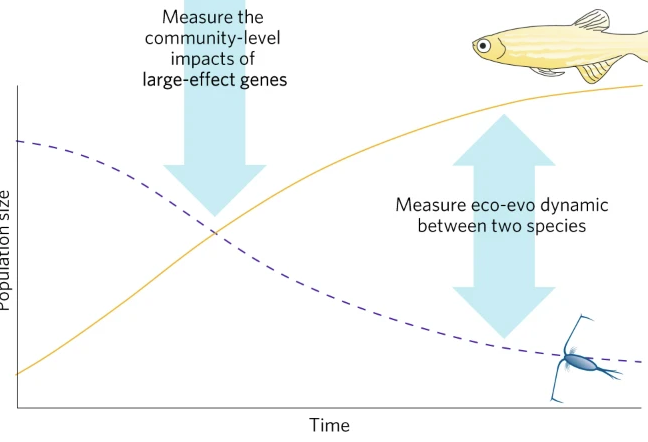
The species-pair stickleback species is a fascinating case study of ecological character displacement and speciation. But what happens to the broader ecological community following speciation? How might that affect populations of primary prey species following divergence in the stickleback predator?
Here is where eco-evo dynamics can explain these outcomes: when strong evolutionary events take place in parallel, they provide a natural experiment to test how adaptation can subsequently feedback to affect the evolution of other species.
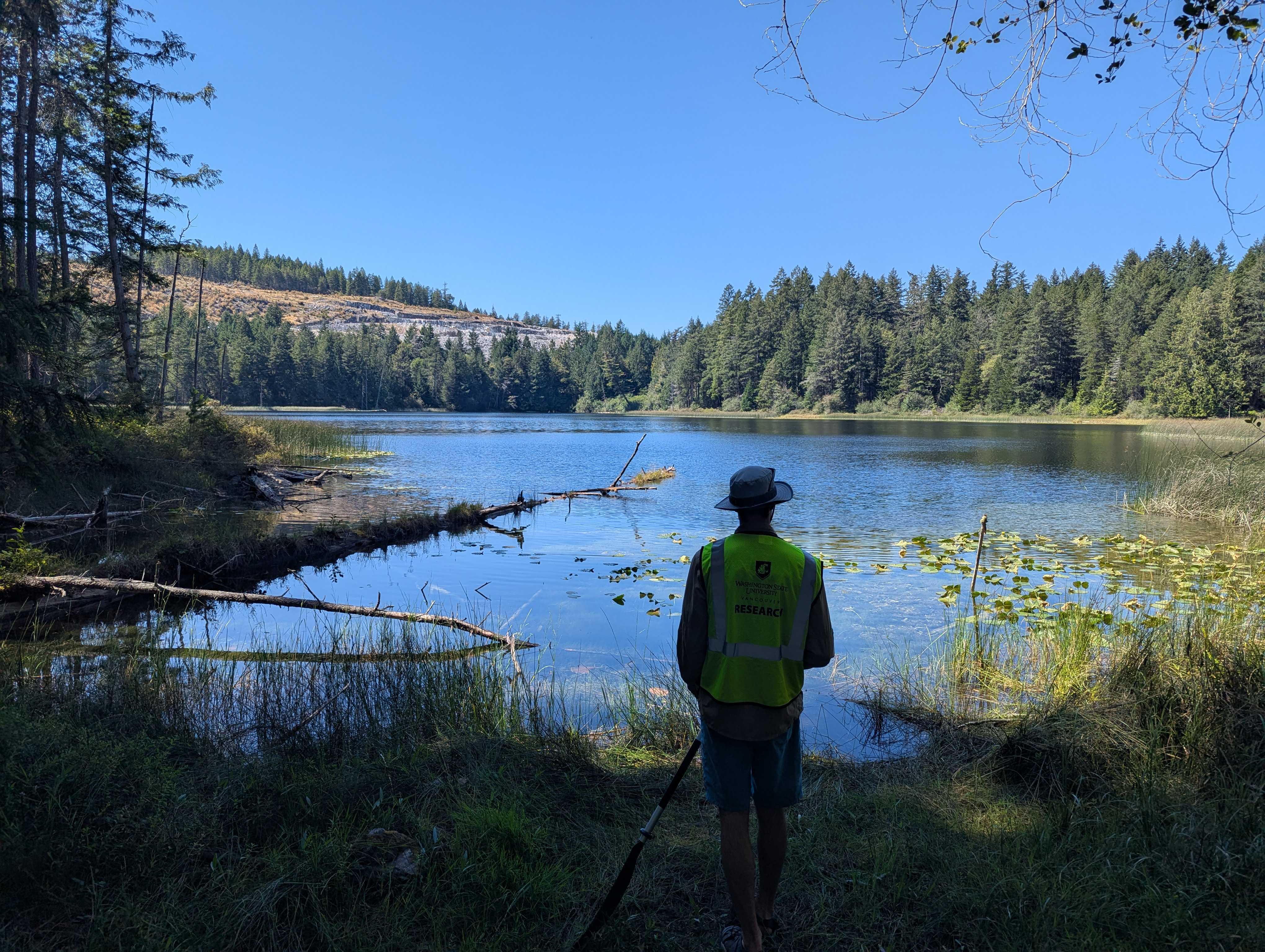
Currently, we are testing for evolutionary divergence in the diaptomid copepod Skistodiaptomus oregonensis in response to ecological speciation of the threespine stickleback Gasterosteus aculeatus fish in coastal British Columbia lakes. We are testing for phenotypic divergence of life history traits in copepods using common garden rearing. Concurrently we are testing for genetic evidence using a genome-wide sequencing approach that can reveal population level divergence and potential signatures of selection.
 {width=”558”}
Previous research:
My previous research at Case Western Reserve University in Cleveland, OH with Ryan Martin investigated these responses in the realm of urbanization in two ways:
Using the urbanization gradient as a ‘space for time substitution’ to explore how urban populations are evolving to the urban heat island compared to non-urban populations, I’ve used populations of a native ant species to explore the evolution of thermal physiology to the urban heat island during winter. You can find the link to this paper here
 {width=”222”}
I’ve used populations of a Collembolan (springtail) within a single urban area to test how environmental variation of multiple traits (temperature and salinity) at small spatial scales affects the evolution of physiological traits. You can find the link to this paper here
Presently, I aim to continue exploring adaptation across seasons with a focus on the overwintering period for insects, adaptation to multiple stressors, and tradeoffs in physiological traits. To expand my research I am interested in how these responses fit into the dynamics between ecology and evolution (eco-evo dynamics) and how responses of one species can feedback to influence other species, communities of organisms, and entire ecosystems.
Influential papers, work, and media;
These are a few selected papers, books, and projects that have influenced my thinking in this field and that continue to excite me with new ideas when I review them!
Papers:
Books:
- Eco-Evolutionary Dynamics

- Urban Evolution

-
Projects / Systems / Ideas:
Podcasts and video series:
Hairston Jr, N. G., Ellner, S. P., Geber, M. A., Yoshida, T., & Fox, J. A. (2005). Rapid evolution and the convergence of ecological and evolutionary time. Ecology Letters, 8(10), 1114–1127. https://doi.org/10.1111/j.1461-0248.2005.00812.x ↩
Hendry, A. P., & Kinnison, M. T. (1999). [Perspective: The Pace of Modern Life: Measuring Rates of Contemporary Microevolution]{.smallcaps}. Evolution, 53(6), 1637–1653. https://doi.org/10.1111/j.1558-5646.1999.tb04550.x ↩
Hendry, A. P. (2016). Eco-evolutionary Dynamics. Princeton University Press. https://doi.org/10.1515/9781400883080 ↩